

You’ve controlled the weeds, prepared the soil, selected your seed mix, and maybe even invested in a new seeder. Now comes the big question: how much seed do you actually need?
Seeding rates can vary widely depending on the species being planted. Some grasses may be seeded as heavily as 15 pounds per 1,000 sq. ft., while others require as little as 5 pounds per acre.
When trying to determine the right rate, growers often hear advice like, “Set your drill narrower than you think and see what happens,” or “Broadcast it until it looks like pepper on eggs.” On the other hand, when given a recommended numeric rate, some may respond with, “That’s not how I seed. I like to lay it down heavy,” while others worry that the suggested rate seems like far too much.
With so much variation in opinions and practices, it can be difficult to determine how much seed to purchase, how to set your drill or broadcast seeder, and what the final application should actually look like in the field.
Below, we’ve outlined general seeding rate guidelines by species, along with tips for drill and broadcast seeding and the potential consequences of over- or under-seeding. Keep in mind that ideal seeding rates can vary depending on factors such as desired stand density, irrigation availability, equipment used, and individual preference.
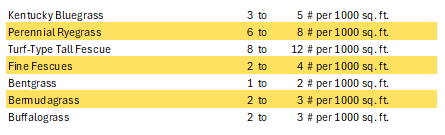
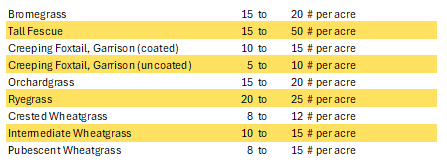
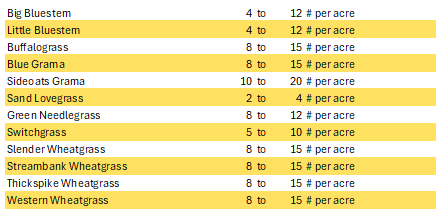
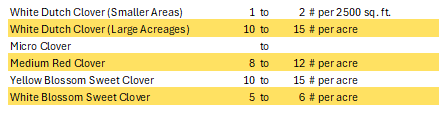
Commonly Used Planting Rates
Turfgrasses:
Pasture and Reclamation Grasses
Native Range Grasses
Alfalfa

Clover
Summer Forages
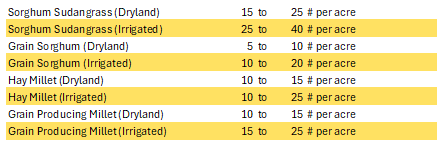
Oats, Barley, Wheat, Triticale, and Rye

Wildflower Mixes

Drill vs Broadcast Seeding
At Buffalo Brand Seed, we highly recommend drill seeding when possible, as it is the most effective way to ensure consistent planting depth and seed distribution. Because drill seeding places seed directly into the soil with greater precision, less seed is typically required.
A common rule of thumb is to double the drill seeding rate when using a broadcast seeder or seeding by hand.
Finding the correct settings on a new drill seeder can require some trial and error. It is always recommended to first check the equipment manual or contact the manufacturer for recommended setting instructions. Otherwise, the common advice to “set your drill narrower than you think and see what happens,” can be a reasonable starting point.
A simple method to calibrate your drill is to measure out one pound of seed and estimate the area it should cover. Then, adjust heavier or lighter according to that estimated distance. For example, if the reccomended seeding rate is 20 pounds per acre, 1 pound should be able to seed approximately 2000 sq ft. If you were only able to cover 500, the drill is set too heavy and should be adjusted.
The exact setting for a seeding rate can vary widely by the seed species, seed size, and the equipment brand, so calibration is always important.
Broadcast Seeding Tips
In our office, we commonly recommend covering the ground with seed, “like pepper on eggs.”
While this is not an exact measurement, this is a helpful reference point for visualization. You want the seed distributed evenly across the surface, but the soil should still be visible between seeds, just like you can still see the eggs beneath the pepper.
Keep in mind that broadcast seeding often requires more seed, but it is better to start lighter and add more if needed. If you happen to run out of seed before finishing the job, you can always come back and pick up more.
Or, if you would prefer to go seed-crazy and apply it extra heavy, we’ll happily welcome you back to the Buffalo Brand Seed office, even if it requires three or four trips in one day.
Why Seeding Rates May Vary
The rate at which we recommend seeding is often a range, and sometimes a rather large range. There are a wide variety of factors that may impact if a grower would like to be at the higher or lower end of this range.
- Desired Turf Density – Many species, such as fine fescues, buffalograss, and ryegrass, can be used in both pasture and turf applications. When planting a smaller turf-application, most growers will prefer a thicker, denser stand. Alternatively, smaller seeding rates on pasture applications can often result in a more natural stand structure, allowing plants more space to mature.
- Irrigation Availability – Water availability plays a major role in establishment success. With limited irrigation, it is unrealistic to expect a thick, dense stand of grass. Under dryland conditions, grass often enters survival mode, bunching up and thins out in order to conserve resources and survive. Higher seeding rates cannot be established with limited water. This is why it is often recommended to lower rates for dryland applications to improve establishment success.
- Broadcasting – Because broadcast seeding distributes seed less precisely than drill seeding, it often requires higher seeding rates to achieve the same final stand density.
The Consequences of Over- or Under-Seeding
It’s common for growers to respond to recommended seeding rates by saying, “I like to seed extra heavy.” This often comes from the belief that more seed equals a better chance of success.
In reality, that’s not always the case.
Using too much seed will lead to intense competition for resources, resulting in thin, weak, and disease prone turf. When each seed is required to fight for sunlight, water, and soil nutrients, it can stunt growth or result in a thinner stand over time. This weakened grass is likely to be easily damaged and unable to recover from adverse conditions. When overcrowded, a grass stand lacks airflow, making it more susceptible to fungal diseases.
Aside from the weaker results, applying seed far above the recommended seeding rate will often lead to unnecessary costs and wasted resources. The soil can only support a certain number of plants, regardless of how much seed is applied.
On the other hand, using too little seed increases the potential for a thin, patchy stand where weeds and soil erosion become more likely.
When there are large haps between plants, soil remains exposed. These open areas create opportunities for weed invasion and soil loss, making it harder for the desired species to establish a healthy stand.
Choosing the right seeding rate is key to establishing healthy turf, pasture, native grasses, and forage crops. Because grass seeding rates can vary widely by species, it’s important to understand recommended rates, proper drill and broadcast seeding techniques, and how to calculate how much seed per acre or per square foot for your specific project. Whether you’re planting turfgrass, pasture mixes, native range grasses, clover, alfalfa, or small grains, following recommended seed application rates can help improve establishment, reduce wasted seed, and produce stronger stands. If you need help determining how much seed to buy or how to calculate seeding rates, the Buffalo Brand Seed team is always here to help.
Need Help Calculating Your Seeding Rate? Call us at 970-356-4710


